

Home › Conditions › Loss of firmness and skin laxity
Loss of firmness and skin laxity
Loss of firmness and skin laxity happen as the skin makes less collagen and elastin, so it becomes looser and less able to spring back. Non-surgical skin tightening can give a modest, gradual improvement, but it is not a facelift. A doctor assesses your skin and tells you honestly what is realistic before you decide anything.
Understanding Loss of Firmness and Skin Laxity
Skin laxity means skin that has lost some of its firmness and elasticity. You might notice sagging skin along the cheeks and jaw, loose skin on the face or neck, or a thin, crepey texture that creases easily. It often becomes noticeable from the forties, though sun exposure, weight change and genetics mean it varies a lot.
Skin tightening results depend on your starting point, so we begin with a doctor’s assessment. Our Sutton Coldfield practice, just north of Birmingham, treats loss of firmness within our regenerative medicine service, which focuses on supporting the body’s own repair and collagen production.
What Causes Loss of Firmness and Skin Laxity?
Collagen gives skin strength and elastin lets it recoil. From early adulthood we make gradually less of both, and several things speed that collagen loss up.
- Natural ageing, which thins the skin and reduces skin elasticity
- Sun exposure, which breaks down collagen and elastin over many years
- Deeper changes in fat and bone with age, which leave skin with less support
- The fall in oestrogen around the menopause, which is linked to thinner, drier skin
- Significant weight loss, which can leave skin with less underlying volume. Losing weight faster than the skin can adapt and recoil, as can happen with GLP-1 weight-loss medicines, can lead to more marked laxity and sagging
- Smoking, which speeds up collagen breakdown
How We Assess Skin Laxity at Aarva
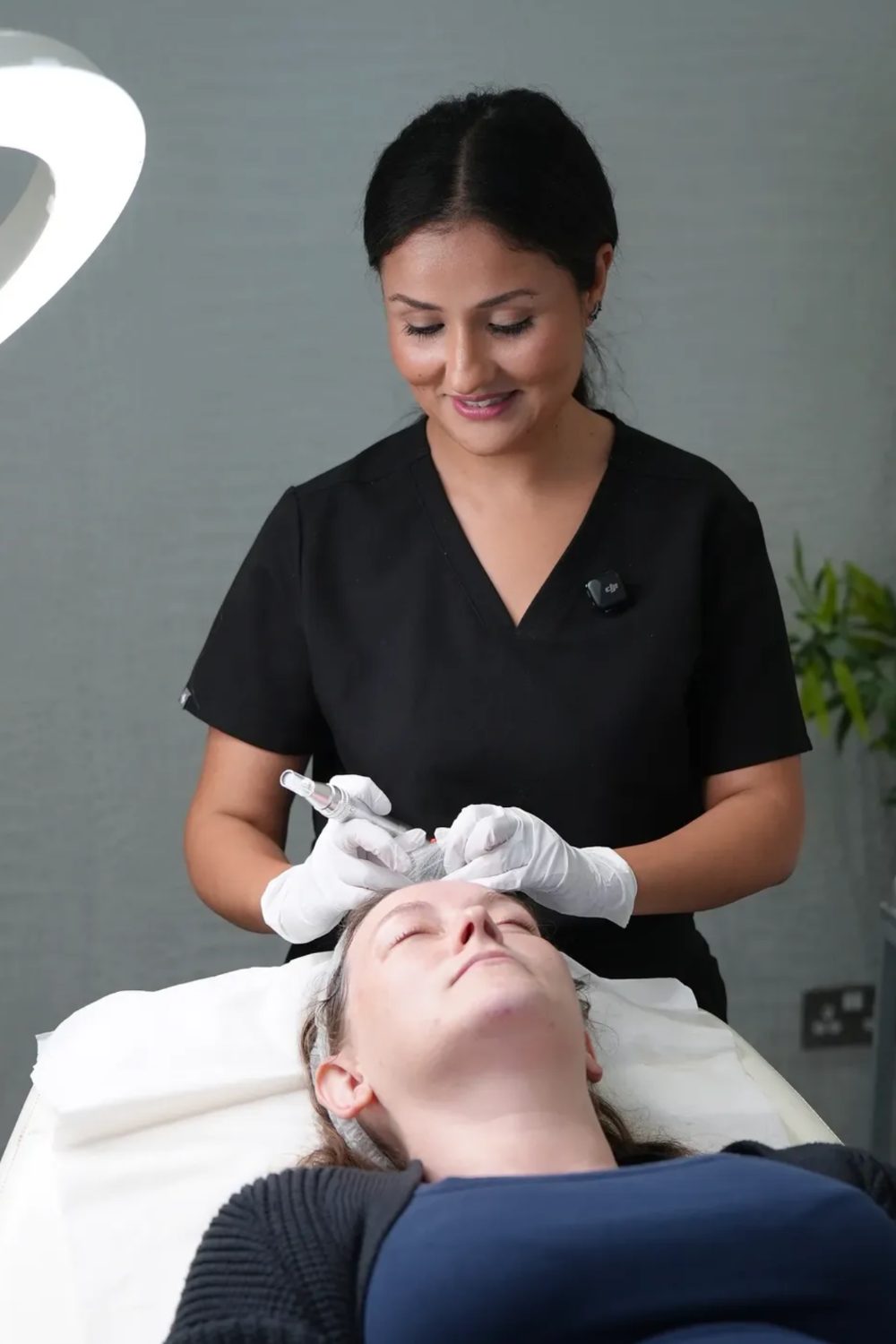
At your skin consultation, a doctor examines your face and neck at rest and in movement, and looks at how much of the change is loose skin and how much is lost volume or deeper tissue change. We ask about your health, medicines, weight history and past treatments.
Aura 3D skin analysis records texture and contour to compare against later. If the sagging is beyond what non-surgical treatment can reasonably help, we will say so and discuss other options, including referral to talk about surgery.
Treatment Options for Skin Laxity
Your plan depends on your assessment and often combines treatments in stages.
A non-invasive treatment that gently heats the deeper layers of skin to encourage collagen production. It can be used on the face, neck and body, and can improve mild to moderate laxity over a course, but it will not lift heavy sagging.
An injectable gel of hyaluronic acid and amino acids, with a small amount of calcium hydroxyapatite, a biostimulator. It adds subtle support and encourages collagen, and is often used where laxity and mild volume loss appear together. It is a refinement, not a lift.
Small injections of hyaluronic acid that improve hydration and the look of crepey skin, particularly on the face and neck. It improves skin quality rather than tightening skin that has dropped.
Hyaluronic acid filler placed to restore lost support in the cheeks, jawline or chin, which can make loose skin less noticeable. It adds structure and does not tighten the skin itself.
A resurfacing laser that stimulates new collagen and improves the texture and firmness of the skin surface. Recovery depends on the depth chosen for your skin.
Daily broad-spectrum sunscreen, not smoking and a steady weight all help protect the collagen you have.
What to Expect
What to expect depends on the treatment chosen, the settings used and the outcomes you agree with your doctor in your plan.
Skin tightening is gradual. Collagen takes time to form, so changes usually show over a few months rather than straight away, and a course of sessions is usual. Redness, swelling or bruising for a few days is common after injectable treatments, and mild redness after radiofrequency.
Improvements are usually modest and natural. Skin keeps ageing, so maintenance sessions are often needed.
How We Approach Skin Laxity at Aarva
Every patient sees a doctor first, and the plan is made by that doctor. We look at what is causing your loss of firmness and are straightforward about what non-surgical skin tightening can and cannot do. If the menopause seems to be playing a part, our women’s health team can help, with everything kept on one medical record.
You get a written treatment plan with clear pricing to take home, to consider before you book. If we think a treatment is unlikely to give you a result worth paying for, we will tell you.
When to See a Doctor Sooner
Loose skin on its own is not a medical problem. See your GP if you have lost weight without trying, if skin changes come with new tiredness, swelling or other symptoms, or if you notice a lump in the skin or neck that is new or growing. If one side of your face suddenly droops, call 999, as this can be a sign of a stroke.
This list is not exhaustive. If you are not sure about something, see a doctor.
Questions Patients Ask About Loss of Firmness and Skin Laxity
Cannot see your question? Our doctors are happy to talk it through at your consultation.
It can give a modest, gradual improvement in mild to moderate skin laxity. It will not match the result of a facelift, and results vary between people.
Options include radiofrequency, collagen-stimulating injectables and skin boosters, usually combined over several months. A doctor can tell you which, if any, is likely to help your skin.
It varies. Because skin continues to age, most people need maintenance sessions to keep their result, and we will explain what to expect for your plan.
The price depends on the treatments in your plan and how many sessions you need. We confirm it in writing before any treatment starts.
Crepey skin often improves with treatments that boost hydration and collagen, alongside daily sun protection. Improvement is usually gradual rather than dramatic.
Why Patients Choose Aarva
Doctor-led from the first appointment
Every consultation is with a doctor, and every plan is written by a practising GP.
GPs still in practice
Our doctors, Dr Saptarshi Saha, Dr Purti Choudhary and Dr Shivani Malhotra, are GMC-registered GPs who still work in general practice.
One medical record
GP, skin and women’s health care sit on one record, so nothing gets lost between appointments.
It starts with a consultation
A doctor assesses you properly, explains your options and gives you a written treatment plan with clear pricing, so every step that follows is the right one.
Come to Us With a Problem, Not a Treatment
For an honest view of what can help, book a consultation or use Find your starting point.
Related conditions: Volume loss · Neck lines and crepey neck · Loose skin, stretch marks and scarring · Jowls, jawline and double chin
Related treatments: LaserMe
This page is general information and does not replace a consultation with a doctor.